

SpendNode Rating
Jupiter is no longer a watchlist card. The free tier is genuinely strong, which is rare, and the value is easy to see once you start from the base card instead of the headline hype.
Hard to argue with the economics on a free card. The spend flow works if you already hold USDC on Solana. Caps still bite, the issuer setup is split by region, and the FX terms are not identical everywhere, which is why it lands just below the top rather than at it.
Cost Efficiency
4.6
Product Utility
4.3
Custody & Trust
3.5
Reliability & UX
4.2
Transparency
4.1

VIRTUAL CARD
Verified

SELF CUSTODY SPEND
Verified

STABLECOIN SPEND
Verified
Our Official Verdict
Spend USDC On-Chain at 150M+ Merchants
The Jupiter Global is no longer just a watchlist product. With 4% base cashback on a free card, permanent referral-tier upgrades to 10%, and zero fees on USD spending, Jupiter now has one of the strongest headline value propositions in the market. The caps still matter, but this is a real rewards card now.
Fees & Charges
Annual Fee
Free
FX Fee
1%
ATM Fee
0%
Requirements
Supported Regions
GLOBAL
Spendable Assets
USDC
Jupiter Global Review
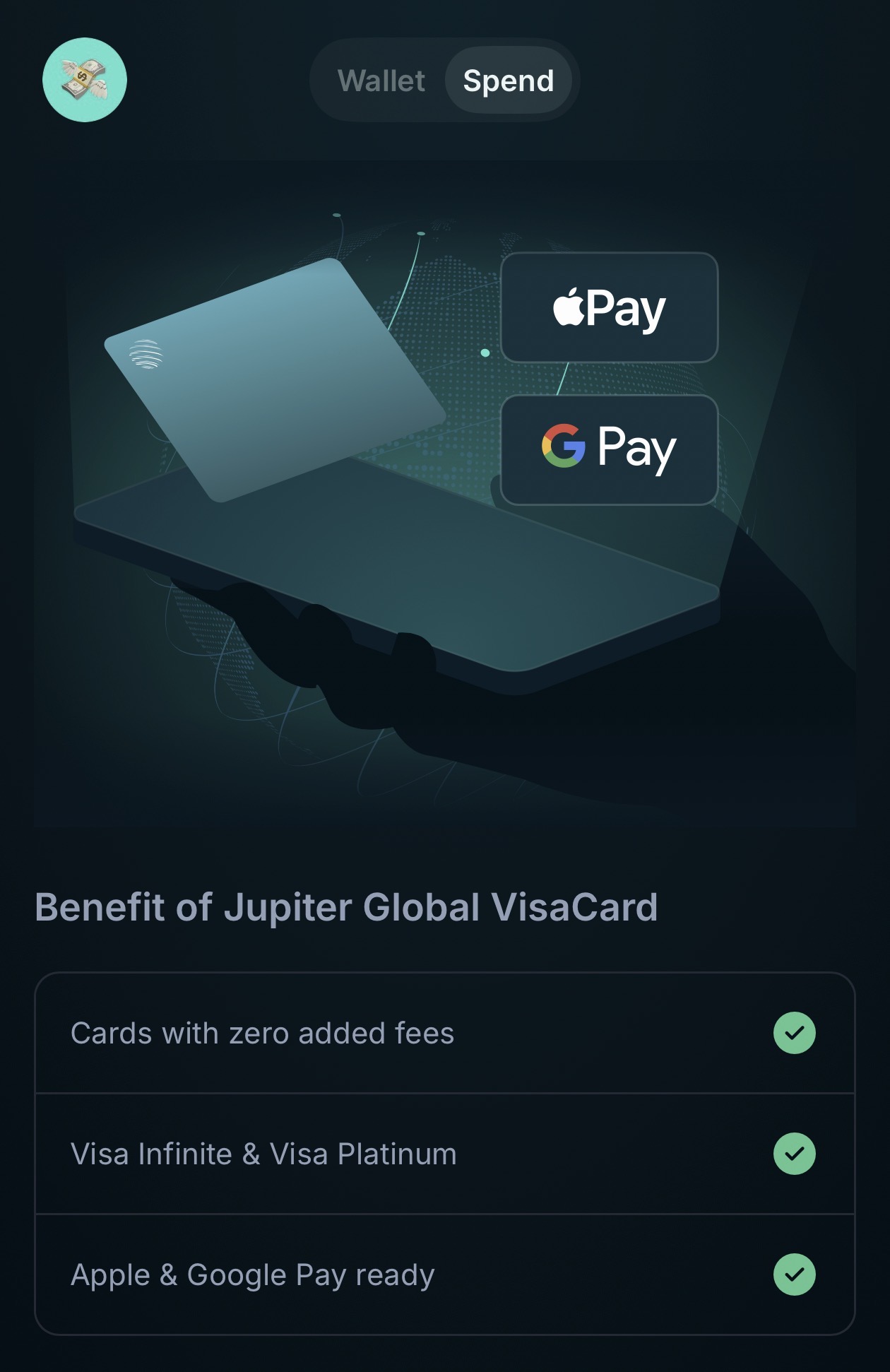
The Jupiter Global card is a virtual Visa Infinite and Visa Platinum debit card that accepts USDC deposits 1:1 to USD with no fee, charges 0% on USD payments, 1% FX on non-USD payments (Rain issuer: Americas, Africa, Middle East, APAC, supported US states) or 1.8% FX (DCS issuer: Singapore, South Korea, Japan, Vietnam, Malaysia, Taiwan, Australia, Thailand, Philippines), with zero annual fee, no spending limits on Rain-issued cards ($50K daily on DCS), Apple Pay and Google Pay support, and QR Pay at mid-market rate with 0% fees for APAC merchants. Launched January 2026 as part of Jupiter Global, the payments arm of Solana's largest DEX aggregator.
The Biggest DEX on Solana Now Has a Spending Card
Jupiter processes more swap volume on Solana than any other protocol. In January 2026, the team launched a virtual Visa card that converts USDC to USD at a 1:1 rate on deposit - no slippage, no fee - and lets you spend that USD balance at any Visa merchant worldwide.
That alone would have made Jupiter a useful Solana spending card. The March 26, 2026 rewards launch is what turned it into something bigger. Jupiter Global now pays 4% cashback at the base tier on a free card, with permanent referral milestones that raise the reward rate to 5%, 8%, and 10%. That does not erase the caps, and it does not make every issuer or user profile equally attractive. But it does change the ranking conversation materially.
We verified the two-issuer fee structure directly from Jupiter's official documentation. In this review, we cover the real FX costs, the new rewards math, QR Pay economics, and who benefits most. The card is issued by two regulated partners. Rain covers the Americas (including 34 US states), Africa, Middle East, and parts of APAC. Rain charges 1% FX on non-USD payments and has no spending limits. DCS covers Singapore, South Korea, Japan, Vietnam, Malaysia, Taiwan, Australia, Thailand, and the Philippines. DCS charges 1.8% FX with a $50,000 daily limit and $990,000 annual limit. Your issuer is determined by your country of residence at KYC - you cannot choose between them.
Both issuers charge 0% on USD payments. The card uses credit-card infrastructure on the Visa network, which means higher merchant acceptance, smoother refunds (3-4 business days), and standard Visa chargeback protections.
Referral note: use code YWQQ5GYL. The referred friend reward is currently $200 after $1,000 in qualifying spend within 30 days of card activation. Terms can change.
Update March 31, 2026 - SpendNode hands-on test: We used the Jupiter Global card for several days on the base tier (4%, no referral bonuses, free). The 4% cashback was real and matched every transaction. Cashback showed as pending for approximately 24 hours, then cleared. Withdrawal after that was near-instant. The card works as advertised. Two things to know: customer support is helpful when you reach them, but replies often take more than a few days. There are also frequent complaints right now about OTP codes not arriving on mobile when trying to view your card details in the app.
Card Specs: What You Are Actually Getting
Physical and Virtual Cards
- Virtual card: Issued in-app after KYC completion (2-4 minutes via SumSub)
- Physical card: Not yet available (planned)
- Mobile wallets: Apple Pay and Google Pay
Payment Network
- Network: Visa Infinite and Visa Platinum (credit-card infrastructure on debit rails)
- Acceptance: All Visa merchants worldwide
- Contactless: Yes (via Apple Pay / Google Pay NFC)
- Card type: Debit (spends from USD card balance)
Security Features
- Card freeze: Instant freeze/unfreeze from the Jupiter app
- Visa protections: Chargeback and dispute mechanisms for fraudulent transactions or merchant failures
- Jupiter ID: SumSub-powered KYC (government ID + selfie; APAC requires proof of address)
- Regulated issuers: Rain and DCS are licensed card issuers
Two Issuers: Rain vs DCS
Your card issuer is assigned by country of residence. You cannot hold cards from both.
| Feature | Rain | DCS |
|---|---|---|
| FX fee (non-USD) | 1% | 1.8% |
| USD payments | 0% | 0% |
| Daily limit | No limit | $50,000 |
| Annual limit | No limit | $990,000 |
| Regions | Americas, Africa, Middle East, APAC, US states | SG, KR, JP, VN, MY, TW, AU, TH, PH |
Rain-supported US states (34): Alabama, Alaska, Arkansas, California, Colorado, Connecticut, Florida, Hawaii, Illinois, Indiana, Iowa, Kansas, Kentucky, Maine, Massachusetts, Michigan, Minnesota, Mississippi, Missouri, Montana, Nebraska, New Hampshire, New Jersey, New York, North Carolina, Oklahoma, Pennsylvania, South Carolina, Tennessee, Texas, Utah, Virginia, West Virginia, Wyoming.
Rain-supported countries: Antigua and Barbuda, Argentina, Bahamas, Barbados, Bangladesh, Belize, Bolivia, Brazil, Cayman Islands, Colombia, Costa Rica, Ivory Coast, Dominican Republic, Dominica, Ecuador, Egypt, El Salvador, Ghana, Grenada, Guatemala, Guyana, Honduras, Hong Kong, Kenya, Mexico, Morocco, New Zealand, Pakistan, Panama, Paraguay, Peru, Saint Kitts and Nevis, Saint Lucia, Saint Vincent and the Grenadines, Senegal, South Africa, Suriname, Trinidad and Tobago, Turks and Caicos, UAE, Uganda, Uruguay, Zambia.
How Spending Works: Deposit USDC, Spend USD
Example: $85 online purchase at a US retailer
Step 1: Deposit USDC
- Open the Jupiter app in Global mode
- Deposit USDC from your Solana wallet
- USDC converts 1:1 to USD at the moment of deposit (no fee, no slippage)
- Your card balance is now held in USD
Step 2: Pay with your card
- Use the virtual card number, Apple Pay, or Google Pay
- Retailer charges $85
Step 3: Settlement
- $85 deducted from your USD card balance
- No conversion at point of sale (balance was already USD)
- Total fee: $0 (USD payment)
Example: EUR 120 dinner in Berlin (Rain issuer)
Step 1: Same deposit process (USDC 1:1 to USD)
Step 2: Pay EUR 120 at the restaurant
Step 3: Rain converts USD to EUR at Visa network rate + 1% FX fee
- FX fee: 1% of EUR 120 = approximately EUR 1.20
- Total fee: approximately EUR 1.20
Step 4: If using DCS issuer instead, FX fee would be 1.8% = approximately EUR 2.16
Fee Deep Dive: The Real Cost
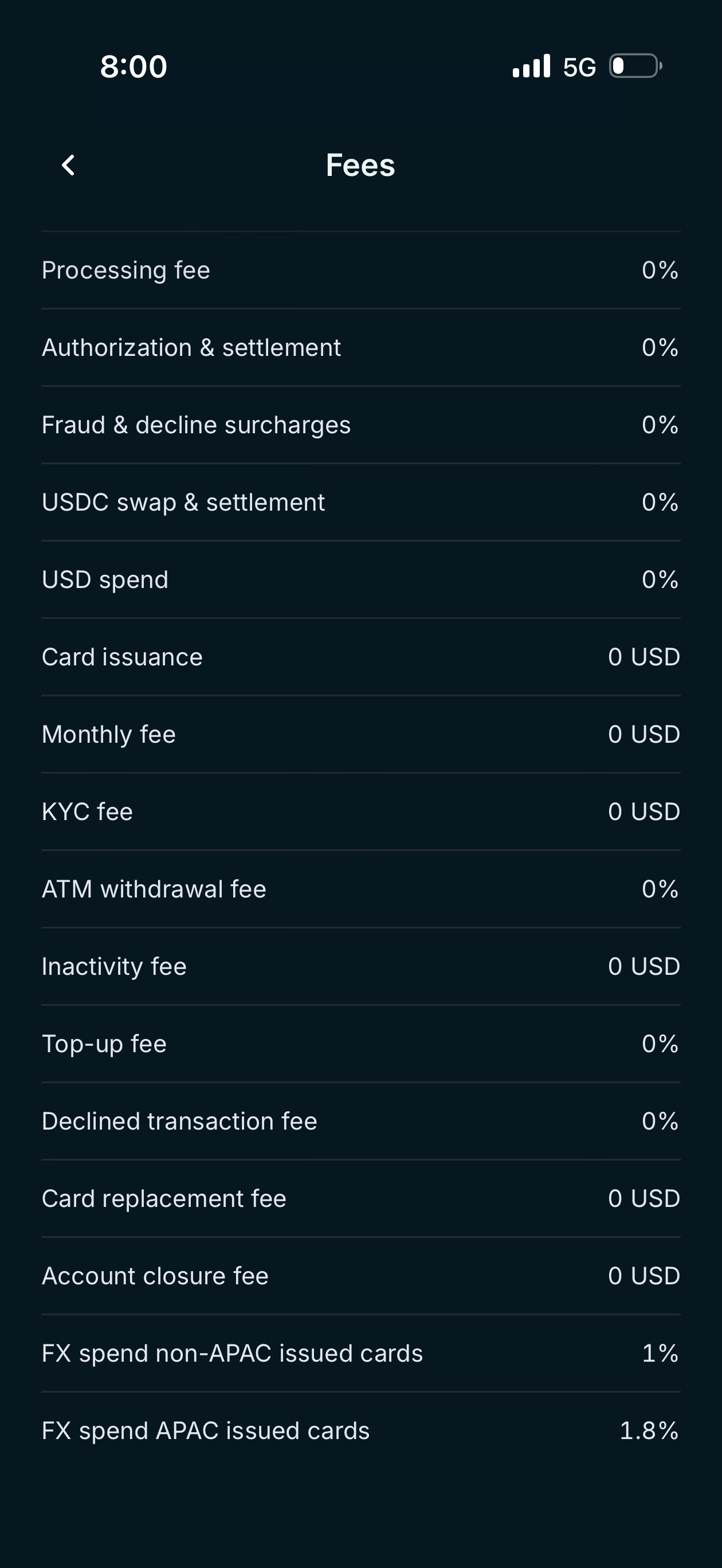
Jupiter's in-app fee page lists 16 line items. Every single one is 0% or $0 except FX on non-USD payments: 1% for non-APAC issued cards (Rain) and 1.8% for APAC issued cards (DCS). No processing fee, no authorization fee, no settlement fee, no USDC swap fee, no top-up fee, no card issuance fee, no monthly fee, no KYC fee, no ATM withdrawal fee, no inactivity fee, no declined transaction fee, no card replacement fee, no account closure fee.
| Fee | Rain | DCS | Notes |
|---|---|---|---|
| Annual fee | $0 | $0 | No subscription |
| USDC deposit | 0% | 0% | Credited 1:1 in USD |
| USD payments | 0% | 0% | Zero cost |
| Non-USD payments (FX) | 1% | 1.8% | Visa network FX rate + issuer fee |
| ATM withdrawal | 0% | 0% | Listed as 0% in app (virtual card only) |
| Refunds | 3-4 business days | 3-4 business days | Back to card balance |
Annual Cost at Different Spending Levels (Non-USD)
| Monthly Non-USD Spend | Rain (1%) Annual Cost | DCS (1.8%) Annual Cost |
|---|---|---|
| $500 | -$60 | -$108 |
| $1,000 | -$120 | -$216 |
| $2,000 | -$240 | -$432 |
| $3,000 | -$360 | -$648 |
Annual Cost for Mixed USD + Non-USD Spending
| Monthly Spend | USD Portion | Non-USD Portion | Rain Annual Cost | DCS Annual Cost |
|---|---|---|---|---|
| $2,000 | 50% ($1,000) | 50% ($1,000) | -$120 | -$216 |
| $2,000 | 80% ($1,600) | 20% ($400) | -$48 | -$86 |
| $3,000 | 100% ($3,000) | 0% | $0 | $0 |
Key insight: Our annual cost calculation shows the more of your spending that is USD-denominated, the cheaper Jupiter becomes. At 100% USD spending, both issuers are completely free before rewards. This is especially relevant for US-based users (Rain) who spend primarily in USD.
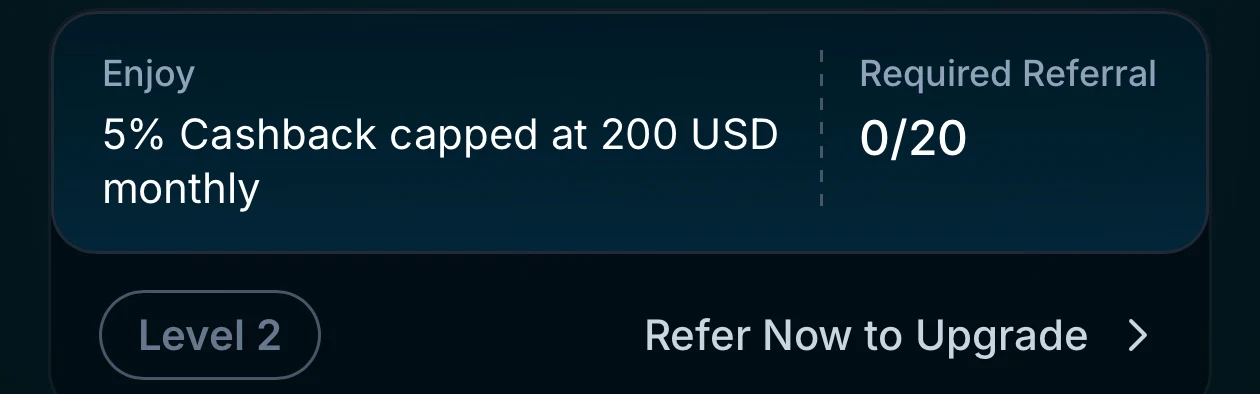
Cashback is now live. Effective March 26, 2026, Jupiter Global pays 4% cashback at the base tier, capped at $100 per month. Referral tiers permanently raise that to 5% ($200 cap), 8% ($500 cap), and 10% ($1,000 cap). Rewards are credited after settlement to the Earn Balance in JupUSD, not at authorization, and can then be moved to the card balance or an external wallet. For a free card, that is a major change to the economics.
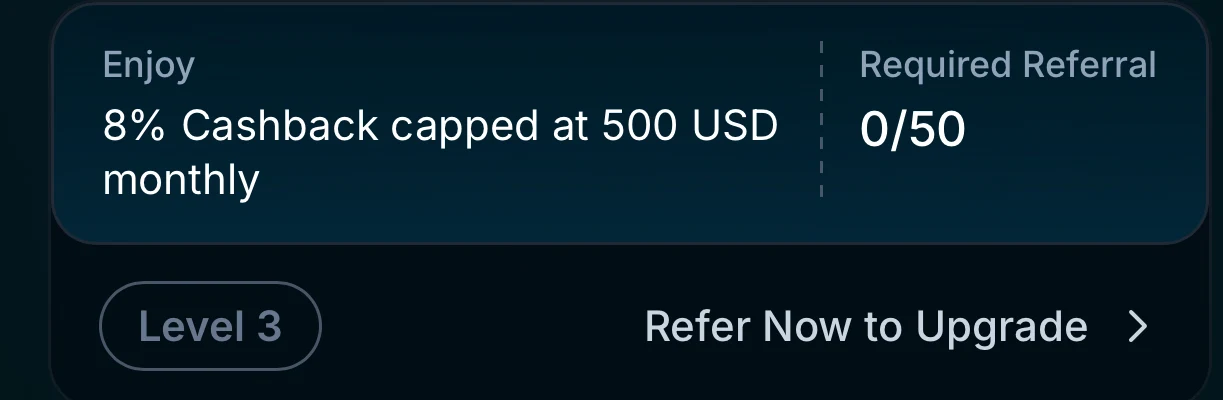
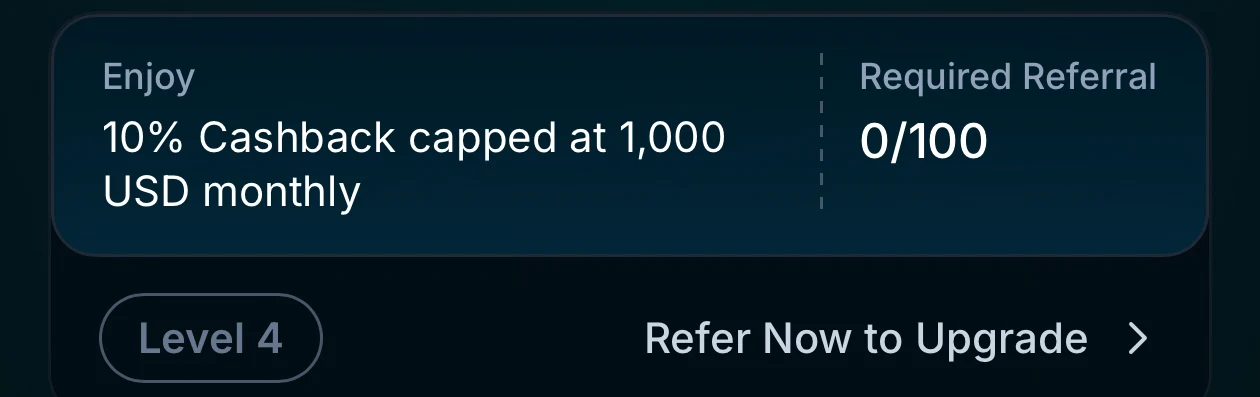
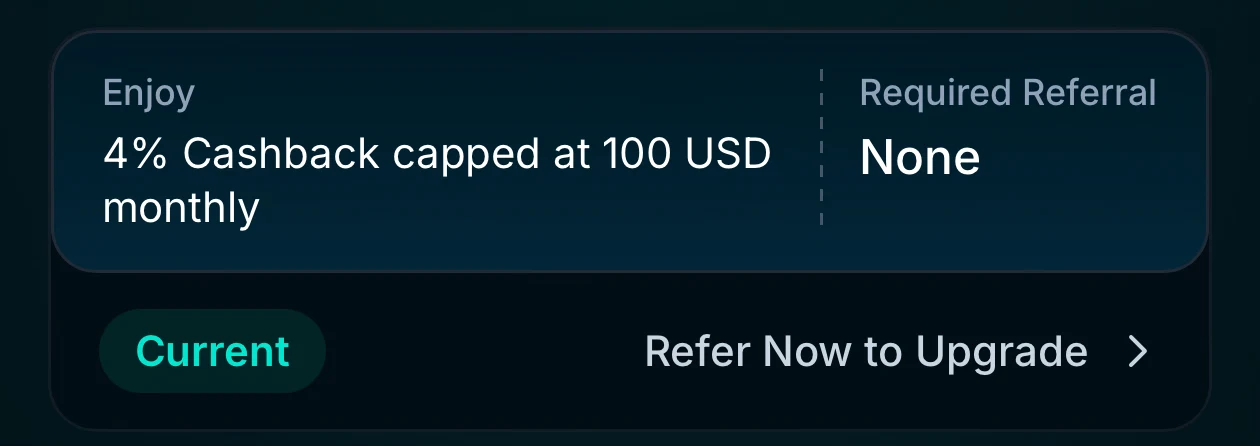
SpendNode app screenshots
Jupiter Global Earn tiers in-app: 4% base cashback with no referrals, then 5%, 8%, and 10% as qualifying referrals accumulate. Caps scale from $100 to $1,000 per month.
Why This Launch Matters
Before rewards, Jupiter was easy to file under "good product, not a top rewards card." It had real utility, real US access, clean USD spending, and the best QR Pay story in APAC, but there was no reason for a cashback-focused user to rank it near the top.
That is no longer true. A free card paying 4% on the first $2,500 of monthly spend is genuinely aggressive. It means:
- Rain users can usually outrun the 1% FX drag comfortably
- USD-heavy users get a very clean fee-plus-rewards combination
- DCS users still need to care about the 1.8% FX rate, but the card is no longer easy to dismiss on economics alone
The right framing is not "Jupiter is a 10% card." The right framing is that Jupiter now starts strong enough at the free tier to matter even before the referral ladder gets involved.
QR Pay: Zero-Fee Payments in APAC
Jupiter QR Pay is available in Singapore, South Korea, Japan, Vietnam, Malaysia, Taiwan, Australia, Thailand, and the Philippines.
| QR Pay Detail | Value |
|---|---|
| Payer fee | 0% |
| Merchant fee | 0% |
| Exchange rate | Mid-market (no spread) |
| Daily limit | $5,000 |
| Peer-to-peer | Yes |
How it works:
- Merchant displays a QR code (or you display yours for P2P)
- Scan with the Jupiter app
- Your USD balance converts to local currency at the mid-market rate with zero spread
- Merchant receives fiat instantly
Why this matters for DCS users: DCS charges 1.8% FX on card payments. QR Pay charges 0% with a better exchange rate (mid-market vs Visa network rate), and it still counts as qualifying spend under Jupiter's rewards terms. That means QR Pay is not just a fee workaround. It is part of the rewards engine too.
The limitation is $5,000 daily and merchant adoption. Not all merchants accept Jupiter QR Pay. Where it is accepted, it is the cheapest payment method available.
Global Fiat Remittance
Jupiter Global includes virtual fiat accounts and international transfers:
| Remittance Detail | Value |
|---|---|
| Virtual accounts | USD, GBP, EUR |
| SWIFT transfers | 200+ countries |
| Local payouts | 22+ currencies |
| Transfer fee | 0% |
| Exchange rate | Mid-market (no spread) |
| Per-transfer limit | $10,000 |
Use cases:
- Receive freelance payments in USD without a traditional bank account
- Send money internationally at mid-market rate with zero fees
- Hold multi-currency balances for travel or business
No other Solana card product offers built-in fiat remittance. This is unique to Jupiter Global.
Limits and Restrictions
| Limit | Rain | DCS |
|---|---|---|
| Daily spending | No limit | $50,000 |
| Annual spending | No limit | $990,000 |
| QR Pay daily | $5,000 | $5,000 |
| Remittance per transfer | $10,000 | $10,000 |
| Supported deposit asset | USDC only | USDC only |
| Card type | Virtual only | Virtual only |
Current Limitations
- Virtual card only - Physical card planned but no date announced
- USDC-only deposits - No other tokens or currencies accepted
- Withdrawals are region-dependent - Being rolled out progressively, not universally available
- Transaction notifications not yet available
- Jupiter ID cannot be deleted once verified
- Country cannot be changed after KYC submission (contact support to reset if incorrect)
What Happens If Jupiter Global Shuts Down?
Your USDC in your Solana wallet (Pure DeFi mode):
- Self-custodial. Your seed phrase works independently of Jupiter. Import into Phantom, Backpack, or any Solana wallet.
- Expected recovery: 100%
Your USD card balance:
- Held by Rain or DCS (regulated card issuers), not by Jupiter directly. If Jupiter ceases operations, the issuer manages wind-down and returns remaining balances.
- Not covered by deposit insurance (FDIC, FSCS).
- Visa chargeback protections apply to individual transactions.
Your virtual fiat account balances (USD/GBP/EUR):
- Dependent on the regulated partner's wind-down process.
- No deposit insurance.
Pending refunds:
- Any merchant refunds in progress (3-4 business days) would be processed by the issuer regardless of Jupiter's status.
Risk comparison:
| Card | On-Chain Assets | Card Balance Risk | Spending Limits |
|---|---|---|---|
| Jupiter Global (Rain) | Self-custody | Issuer-dependent | No limit |
| Jupiter Global (DCS) | Self-custody | Issuer-dependent | $50K daily |
| Solflare | Self-custody | Issuer-dependent | $30K/month |
| xPlace Standard | Self-custody | Issuer-dependent | $5K/month |
| KAST K Card | Custodial | Custodial | $3K/month |
Risk level: Very low for on-chain USDC. Low-to-moderate for card/fiat balances. Rain and DCS are regulated issuers, which provides more protection than unregulated card programs. Jupiter's dominance in Solana DeFi suggests operational stability, but the Global payments arm is a January 2026 launch.
Real User Scenarios
Scenario 1: Jake (Austin TX, Rain Issuer, $3,500/month)
Setup:
- Jupiter Global card (Rain, free)
- 80% USD spending (online, subscriptions, domestic)
- 20% non-USD spending (travel, international purchases)
Monthly math:
- Cashback: 4% base tier capped at $100/month = +$100
- USD portion ($2,800): 0% fee = $0
- Non-USD portion ($700): 1% FX = -$7
- Net monthly result: +$93
- Net annual result: +$1,116
His verdict: "As a Solana developer in Texas, this has gone from a clean off-ramp to a real daily card. I max the base cashback cap every month, my USD spend is free, and the small amount of travel FX barely dents the reward."
Scenario 2: Mei Lin (Singapore, DCS Issuer, SGD 4,000/month)
Setup:
- Jupiter Global card (DCS, free)
- 100% SGD spending (non-USD)
- Uses QR Pay at supported merchants
Monthly math:
- Cashback: 4% base tier capped at $100/month = +$100
- Card payments (60%): SGD 2,400 at 1.8% FX = approximately -SGD 43
- QR Pay (40%): SGD 1,600 at 0% (mid-market) = $0
- Net monthly result: roughly +SGD 92 after FX
- Net annual result: roughly +SGD 1,104
Her verdict: "The 1.8% DCS rate still matters, but the card is no longer easy to dismiss. Once cashback went live, the base tier alone became enough to offset the FX drag for my spending. QR Pay makes the math even better where it is accepted."
Scenario 3: Carlos (Mexico City, Rain Issuer, $1,800/month)
Setup:
- Jupiter Global card (Rain, free)
- 30% USD online purchases, 70% MXN local
- Uses fiat remittance to receive USD freelance payments
Monthly math:
- Cashback: 4% of $1,800 = +$72
- USD portion ($540): 0% = $0
- MXN portion ($1,260): 1% FX = -$12.60
- Fiat remittance (receiving USD): 0% = $0
- Net monthly result: +$59.40
- Net annual result: +$712.80
His verdict: "The virtual USD account changed my freelance workflow. Now the card math works too. I get paid in dollars, spend from the same pool, and the 4% base cashback more than covers the FX on local purchases."
How the Jupiter Global Card Compares
For Solana USDC holders:
- Solflare Card: 1% FX on all non-USD, raffle rewards, EEA/UK only. Same FX as Jupiter Rain but much narrower availability. Solflare has 9K+ App Store reviews (established). Jupiter has 56 (new).
- xPlace Standard: 1% FX + 1% transaction fee (2% total), global, 0.5% cashback at Standard. Jupiter Rain is now clearly stronger at the base tier for users who can capture the 4%/$100 monthly reward cap.
- KAST K Card: 0.5-1.75% FX, 2% points + 4% $MOVE, 2-min KYC. KAST still has a simpler rewards story for non-USD spenders, but Jupiter now starts higher on base cashback and has stronger US positioning.
For US residents specifically:
- Jupiter (Rain, 34 states) is one of very few Solana-native cards available in the US. Gemini offers a credit card with 4% cashback (US only) but is not Solana-native. Coinbase offers up to 4% but on a custodial exchange card.
For APAC users:
- DCS-issued card has 1.8% FX (higher than Rain). But QR Pay at 0% and mid-market rate is the best payment option in the region. If merchant adoption grows, QR Pay makes the DCS FX rate less relevant.
For cashback seekers:
- Jupiter is now one of the strongest free debit-card reward stories in the market. The base tier is 4% on a free card with a $100 monthly cap, and referral tiers go to 5%, 8%, and 10% with higher caps. That is not automatically better than every uncapped or easier-to-scale alternative, but it is far stronger than the old "wait for roadmap" story.
The Verdict: Is the Jupiter Global Card Worth It in 2026?
Use Jupiter Global if:
- You hold USDC on Solana and want to spend it without an exchange withdrawal
- You are based in the US (34 supported states via Rain) and need a Solana spending card
- Your spending is heavily USD-denominated (0% fee on all USD payments)
- You are in APAC and can use QR Pay at supported merchants (0% fee, mid-market rate)
- You need fiat remittance (USD/GBP/EUR virtual accounts, SWIFT to 200+ countries, 0% fee)
- You want no spending limits (Rain issuer)
Skip Jupiter Global if:
- You spend far above the monthly cap and want uncapped or easier-to-scale reward economics
- You are a DCS user and want the lowest FX rate (1.8% is higher than Solflare's 1% or Gnosis Pay's 0%)
- You need a physical card or ATM withdrawals (virtual only)
- You need a battle-tested card with a multi-year track record
- Your state is not in Rain's supported list (16 US states not covered)
Final verdict: Jupiter Global crossed an important line on March 26, 2026. Before that, it was a very capable Solana spending product with unusually good payments infrastructure. After the rewards launch, it became one of the best free crypto cards worth seriously considering. A 4% base tier on a free card is strong on its own. Add 0% on USD payments, 1% FX on Rain, QR Pay at 0%, virtual fiat accounts, and referral tiers that scale far beyond the base offer, and Jupiter now has one of the highest-upside free-card stacks in the market. The cap structure still stops it from being an automatic winner for every heavy spender, and DCS users still face a weaker FX profile than Rain users. But for users whose spend sits inside the cap, especially US-based Solana users, Jupiter has clearly moved into the top tier.
Sources and Verification
All card specs, fees, limits, and country lists verified from:
Two issuers (Rain and DCS) confirmed with region-specific fees and limits. Rain supported countries and US states verified from official documentation. QR Pay availability, limits, and mid-market rate confirmed. Remittance features and limits confirmed.
User scenarios are composite illustrations based on typical spending patterns. FX costs vary with Visa network rates and spending currency.
Written by Aleksandar Dukic
FAQ
How do you choose Jupiter Global crypto cards?
We compare verified issuer sources, fees, and eligibility. Availability can change, so confirm with the issuer before applying.
Do all cards in this list offer the same benefits?
No. Each issuer defines its own program terms. Review the sources on each card profile.
Are these rankings or recommendations?
No. Lists are filtered views of cards in our database and do not imply rankings.
This is a debit card. Some merchants with pre-authorization holds (hotels, car rentals) may temporarily hold funds beyond the transaction amount.
Fees shown above are the card's disclosed fees. Additional costs may apply: Visa/Mastercard network spread (typically 0.5-0.9%), crypto-to-fiat conversion spread at point of sale, and blockchain gas fees for on-chain top-ups.
Found any issues?
User Reviews
Reviews are moderated and may take a moment to appear.
Recent Updates to Jupiter Global
- Corrected the KAST comparison so it no longer flattens KAST into simple cashback
- Kept the page aligned with Jupiter's current positioning against KAST as 2% points plus 4% $MOVE, not plain 2% cashback
- Rebuilt the product review around the live 4% base cashback launch, including tier math, cap framing, and revised user scenarios
- Added the in-app Earn tier screenshots and rewrote the verdict to reflect Jupiter's stronger position among free crypto cards
- Updated the hero lede, referral note, and CTA to reflect the current offer and apply destination