Ready's 340% Card Spend Surge Defies a Brutal Market
While the broader crypto market has been in freefall since October 2025, one metric is moving sharply in the opposite direction. Ready, the self-custody USDC debit card, reported on February 4 that its card spend has increased 340% since October 10. During that same period, Bitcoin dropped 37.5%, Ethereum fell 48.5%, and Solana collapsed 55.9%.
The contrast is stark. Major crypto assets have shed roughly a third to half their value, yet a crypto card platform is seeing explosive growth in actual spending. The divergence tells a story about where crypto utility is heading during downturns.
Why Stablecoin Cards Thrive When Markets Don't
The mechanics behind this divergence are straightforward. Ready operates exclusively on USDC, Circle's dollar-pegged stablecoin. When a user loads their Ready card and taps it at a merchant, they're spending a stable asset, not a volatile one. Their purchasing power doesn't fluctuate with Bitcoin's price swings.
This creates a natural flight-to-utility pattern during bear markets. As portfolio values decline, users who still want to spend crypto gravitate toward stablecoin infrastructure. Instead of selling BTC at a loss to cover expenses, they convert to USDC and spend through a card that preserves their dollar value. The 340% growth figure likely reflects this exact behavior: more users converting volatile holdings to stablecoins and routing spending through cards.
Stablecoin transaction volumes broadly support this thesis. On-chain data from late 2025 showed stablecoin transfers hitting record highs even as token prices declined. The market was shrinking in value but growing in utility.
The Self-Custody Difference in a Trust Crisis
Ready's architecture adds another layer to the story. Unlike most crypto cards that require users to deposit funds into a custodial account, Ready operates as a self-custody solution. Your USDC stays in your own wallet until the moment you make a purchase. The card draws from your wallet at the point of sale using Mastercard rails.
In a bear market, where exchange solvency concerns resurface and platforms occasionally freeze withdrawals, self-custody isn't just a philosophical preference. It's practical risk management. Users don't have to trust a third party with their spending funds. The 2022 FTX collapse demonstrated what happens when custodial platforms fail, and crypto users have long memories.
Ready's model eliminates that counterparty risk entirely. Your funds, your keys, your spending. The card is simply the last-mile connection to the traditional payment network.
What Ready's Card Actually Offers
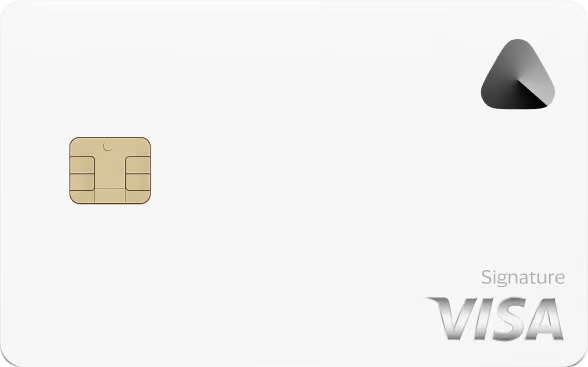
For context, Ready offers two card tiers. The Ready Metal is a premium 16-gram metal card (available in gold or standard metal finishes) with 3% cashback and exclusive perks. The Ready Lite is a plastic option with core features at a $6.99 shipping cost.
Both cards work anywhere Mastercard is accepted globally. Spending happens in any Mastercard-supported currency, with USDC converted to local fiat at the official Mastercard exchange rate at the time of purchase. The card charges zero foreign exchange fees, making it particularly attractive for travelers and digital nomads.
The card currently supports Google Pay for contactless spending, with Apple Pay integration in development. Availability is limited to the UK and European Economic Area (EEA), with broader geographic expansion planned.
Putting 340% Growth in Context
A critical caveat: percentage growth without absolute numbers can be misleading. Ready is a relatively young platform operating in a limited geographic market. Growing card spend 340% from, say, $1 million to $4.4 million is a very different story than growing from $100 million to $440 million.
Ready did not disclose absolute spend volumes in the announcement. Without that baseline, the 340% figure, while impressive on its face, needs to be understood as growth from an early-stage starting point. The trajectory is encouraging, but the scale remains unconfirmed.
That said, the directional signal matters. Even if the absolute numbers are modest, a crypto card platform growing spending 340% during a period when the entire market is contracting validates the product-market fit for stablecoin spending cards.
The Broader Stablecoin Card Landscape
Ready isn't the only card operating in stablecoin territory. Several competitors offer similar functionality with different tradeoffs. Gnosis Pay runs on EURe and GBPe stablecoins with self-custody on Gnosis Chain. Wirex supports multiple stablecoins with cashback in its native token. Crypto Dot Com and Coinbase both allow stablecoin spending, though through custodial models.
The bear market is likely benefiting all stablecoin-compatible cards to some degree. When volatile assets decline, the relative appeal of stable-value spending increases across the board. Ready's 340% figure may be the most dramatic data point, but the trend extends beyond any single platform.
For users evaluating crypto cards during a downturn, the key factors shift. Cashback rates on volatile tokens matter less when those tokens are dropping 40-50%. Stablecoin support, self-custody, low fees, and actual usability become the primary decision criteria. Cards that check those boxes are the ones that stay in wallets during bear markets.
FAQ
What is Ready? Ready is a self-custody crypto debit card that lets you spend USDC anywhere Mastercard is accepted. Your funds stay in your own wallet until you make a purchase.
How did Ready's card spend grow 340% during a crash? Ready runs on USDC, a stablecoin pegged to the US dollar. Users converting volatile crypto to stablecoins and spending through the card drove the growth, since their purchasing power remains stable regardless of market conditions.
Where is the Ready card available? Currently available in the UK and European Economic Area (EEA), with plans to expand to additional regions.
Does Ready charge foreign exchange fees? No. Ready charges zero FX fees. Currency conversion happens at the official Mastercard exchange rate at the point of sale.
Overview
Ready's 340% card spend growth since October 2025, during a period when BTC, ETH, and SOL all declined 37-56%, highlights the growing role of stablecoin-native cards during bear markets. The self-custody USDC card eliminates counterparty risk while preserving spending power through dollar-pegged stability. While the percentage growth lacks absolute volume context and the platform operates in limited markets, the directional trend validates the thesis that crypto card utility increases when speculative value decreases. For users navigating a downturn, stablecoin cards with self-custody, zero FX fees, and broad merchant acceptance represent the practical end of the crypto spending spectrum.