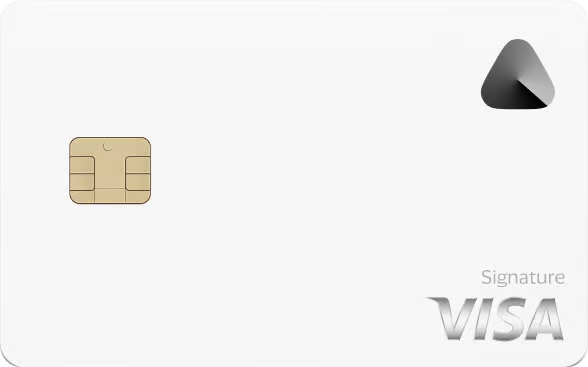
The rise of self-custody crypto cards marks a fundamental shift in how we think about "your keys, your coins" in everyday spending. Two cards lead this movement: Gnosis Pay (Gnosis Chain-native with Safe multi-sig) and Tria Signature (multi-chain with MPC technology).
This isn't just a feature comparison—it's a clash of custody philosophies. Which approach wins depends on what you value: transparent on-chain security or seamless multi-chain UX.
Quick Comparison Table
| Feature | Gnosis Pay | Tria Signature |
|---|---|---|
| Custody Model | Multi-sig (Safe) | MPC (Multi-Party Computation) |
| Chains Supported | Gnosis Chain only | 8+ chains (Ethereum, Polygon, Base, etc.) |
| KYC Required | Yes | Yes |
| Card Network | Visa | Visa |
| Monthly Fee | €1-3 | $0 (promotional) |
| Foreign Exchange Fee | ~0.5% | ~1% |
| ATM Withdrawal | €2 + 2% | $2.50 + 2.5% |
| Staking Required | No | No |
| Smart Contract Risk | Visible on-chain | Abstracted away |
| Recovery Method | Guardian approval | MPC shard recovery |
| Best For | Ethereum purists, DeFi users | Multi-chain users, beginners |
Security Model: Multi-Sig vs MPC
Gnosis Pay: Multi-Sig Transparency
Uses Gnosis Safe (now Safe Wallet) 2-of-3 multi-signature:
- Guardian 1: Your phone/hardware wallet
- Guardian 2: Gnosis Pay backend
- Guardian 3: Recovery key (stored securely)
To spend:
- You approve the transaction on your phone
- Gnosis Pay backend co-signs automatically
- Transaction executes on Gnosis Chain
Pros:
- Fully transparent on-chain
- You can verify guardian addresses
- Standard Safe Wallet contract (battle-tested)
- Can add/remove guardians via Safe UI
Cons:
- Limited to Gnosis Chain (bridging required for other assets)
- Guardian management adds complexity
- Smart contract interaction required for every tx
Tria: MPC Key Sharding
Uses Multi-Party Computation to split your private key into 3 shards:
- Shard 1: Your device
- Shard 2: Tria server
- Shard 3: Cloud backup (encrypted)
To spend:
- You initiate transaction on Tria app
- Your device shard + Tria server shard collaborate cryptographically
- Transaction signs without reconstructing full key
Pros:
- Works across 8+ chains seamlessly
- No guardian management
- Looks like normal wallet to blockchains
- Easier UX for non-technical users
Cons:
- Trust in Tria's MPC implementation
- Shards are off-chain until signing
- Less transparent than multi-sig
- Newer technology (less battle-tested)
Chain Support: Single vs Multi-Chain
Gnosis Pay: Gnosis Chain Only
Advantages:
- Ultra-low fees ($0.001 per transaction)
- Optimized for payments (5-second finality)
- Direct integration with Gnosis ecosystem
- No bridge delays
Limitations:
- Must bridge assets from Ethereum/other chains
- Limited DeFi ecosystem on Gnosis Chain
- Fewer token options
Who this works for:
- Users willing to bridge assets once
- Gnosis ecosystem participants
- Those prioritizing low on-chain fees
Tria: 8+ Chains Supported
Supported chains:
- Ethereum, Polygon, Arbitrum, Optimism, Base, Avalanche, BNB Chain, Gnosis
Advantages:
- Spend from any supported chain
- No bridging required
- Access full DeFi ecosystems
- Multi-chain asset management
Limitations:
- Higher on-chain fees (depends on chain)
- Complexity of managing 8 wallets
- Gas fees vary by network
Who this works for:
- Multi-chain DeFi users
- Those holding assets across networks
- Users who don't want to bridge
Fees: The Hidden Costs
Gnosis Pay Fee Breakdown
Monthly fees:
- Basic: €1/month
- Premium: €3/month (higher limits)
Transaction fees:
- On-chain: ~$0.001 (negligible)
- FX fee: ~0.5% (competitive)
- ATM: €2 + 2%
Annual cost for €10K spending: €12-36 (monthly) + €50 (FX) = €62-86/year
Tria Fee Breakdown
Monthly fees:
- Currently $0 (promotional period)
Transaction fees:
- On-chain: Varies by chain ($0.01-$5)
- FX fee: ~1%
- ATM: $2.50 + 2.5%
Annual cost for $10K spending: $0 (monthly) + $100 (FX) = $100/year
Winner on fees: Gnosis Pay (if you bridge once and stay on Gnosis Chain)
Recovery & Account Access
Gnosis Pay Recovery
If you lose your phone:
- Access Safe Wallet via recovery key
- Remove compromised guardian
- Add new guardian (your new phone)
- Gnosis Pay automatically updates backend
Risk: If you lose 2 of 3 guardians, funds are stuck unless you set up social recovery.
Tria Recovery
If you lose your phone:
- Install Tria app on new device
- Authenticate with cloud backup shard
- Tria server shard + cloud shard = recovered access
Risk: If Tria servers go down AND you lose your device, you need the backup shard (which is encrypted).
Winner on recovery: Tria (simpler UX, but requires trust in Tria's infrastructure)
Real-World Usability
Gnosis Pay UX:
- Install Safe Wallet mobile app
- Fund your Safe with xDAI or bridged assets
- Link Safe to Gnosis Pay card
- Approve spending via app
User feedback:
- "Feels like using a hardware wallet for every purchase" (secure but friction)
- "Bridging assets to Gnosis Chain is annoying"
- "Love seeing transactions on-chain immediately"
Tria UX:
- Install Tria app
- Fund any of the 8 supported chains
- Card automatically pulls from cheapest chain
- Spending happens without explicit approval
User feedback:
- "Feels like a normal card, but I know I control it"
- "Multi-chain support is killer—no bridging"
- "Wish I could see the MPC process on-chain"
Winner on UX: Tria (unless you're a power user who wants full control)
Which Card Wins for You?
Choose Gnosis Pay if you:
- Trust transparent, on-chain security over convenience
- Primarily use Gnosis Chain or Ethereum
- Want battle-tested Safe multi-sig
- Don't mind bridging assets once
- Value open-source, auditable code
Best for: Ethereum purists, DeFi power users, privacy advocates
Choose Tria if you:
- Hold assets across multiple chains
- Want the easiest self-custody experience
- Trust MPC technology (Fireblocks, Coinbase use it)
- Prioritize UX over on-chain transparency
- Don't want to manage guardians
Best for: Multi-chain users, beginners, mainstream adoption
Choose Both if you:
- Want the best of both worlds
- Use Gnosis Pay for Ethereum/Gnosis spending
- Use Tria for multi-chain assets
- Can justify two monthly fees
The Bigger Picture: Self-Custody Cards in 2026
Both Gnosis Pay and Tria represent the future of crypto spending:
- No exchange custody risk (your keys, your coins)
- No staking requirements (unlike Crypto.com, Binance)
- Real ownership (you can export keys/guardian control)
The choice between them isn't about "better" or "worse"—it's about philosophy:
- Gnosis Pay: Transparent security (multi-sig on-chain)
- Tria: Seamless UX (MPC abstraction)
For most users, Tria's multi-chain support and simpler UX will win. For Ethereum maximalists and those who demand on-chain transparency, Gnosis Pay is the purist choice.
Alternatives to Consider
If neither fits your needs:
MetaMask Card (Rumored 2026):
- Native MetaMask integration
- Likely MPC-based like Tria
- Broader distribution than Tria
Coinbase Card (Not self-custody):
- Custodial but familiar
- Best for beginners who aren't ready for self-custody
Hardware Wallet + Card (Ultimate security):
- Ledger/Trezor + spending account
- Transfer only what you need to spend
Bottom Line
Gnosis Pay wins on:
- Transparent on-chain security
- Lower fees (if you bridge once)
- Ethereum ecosystem alignment
- Open-source auditability
Tria wins on:
- Multi-chain support (8+ chains)
- Simpler UX (no guardian management)
- Beginner-friendly self-custody
- No monthly fees (for now)
Our take: If you're an Ethereum/Gnosis ecosystem user who values transparency, choose Gnosis Pay. If you're a multi-chain user who wants self-custody without complexity, choose Tria.
For most users in 2026, Tria is the better choice purely due to multi-chain support. But Gnosis Pay is the gold standard for those who demand open, auditable security.
Further Reading: