


SpendNode Rating for Tria Virtual Card
Tria Virtual is the easy way into the Tria system. It is still a rewards card first in the way most people will shop it.
Entry door to the Tria system. People will compare it on cashback and fees first, self-custody second. That is fine. The numbers are respectable at this tier, and the wallet-control story adds a layer most free rewards cards do not have. Not the strongest Tria card, but not trying to be.
How It Competes
Cost Efficiency
3.6
Product Utility
4.4
Custody & Trust
4.4
Reliability & UX
4.3
Transparency
4.0

VIRTUAL CARD
Verified

SELF CUSTODY SPEND
Verified

CASHBACK
Verified
Tria Virtual Card Overview
Instant Virtual Entry: 1.5% Cashback + Apple Pay
The Tria Virtual Card is the easiest way to start using Tria. For $25/year, you get 1.5%% cashback on the first $100 of monthly spend (then 0.5%) and Apple Pay support. An affordable entry point for users who want self-custodial spending with cashback.
Fees & Charges
Annual Fee
$25 $0 (free for a limited time)
FX Fee
1%
ATM Fee
TBD
Requirements
Supported Regions
EEA, UK, US, GLOBAL
Spendable Assets
ETH, USDC, USDT
On This Page
What Is the Tria Virtual Card?
The Tria Virtual Card is a $25/year self-custodial Visa debit card powered by account abstraction on Optimism, Arbitrum, and Solana. It earns 1.5% cashback on the first $100 of monthly spend (then 0.5% above that), with a 1% FX fee on non-USD spend, a 0.5% fee on every payment, and 0% deposit fees.
On top of that it carries up to 15% APY on wallet balances, $2,000 Price Protection, $10,000 Purchase Protection, instant virtual issuance, Apple Pay and Google Pay, support for 1,000+ crypto assets, and a $1,000,000 daily transaction limit. Available in EEA, UK, US, and global markets. Tria is currently waiving the fee (free) for a limited time; the standard price is $25/year.
Among self-custodial crypto cards, the Tria Virtual Card stands out for what you get at $25/year: self-custodial spending with 1.5% cashback on the first $100/month (then 0.5%), zero deposit fees, $2,000 Price Protection, and $10,000 Purchase Protection. Your crypto stays in your account abstraction smart account until you swipe.
The instant virtual issuance means you can add the card to Apple Pay or Google Pay and start spending within minutes of signing up. The $1,000,000/day limit is far more than an entry tier needs, and the 1,000+ supported crypto assets mean you can spend from a diverse portfolio without swapping to a single stablecoin first.
This is the low-cost way to test the Tria ecosystem before considering the Signature ($109/yr, 4.5% to $1K/mo) or Premium ($250/yr, 6% to $2K/mo) tiers.
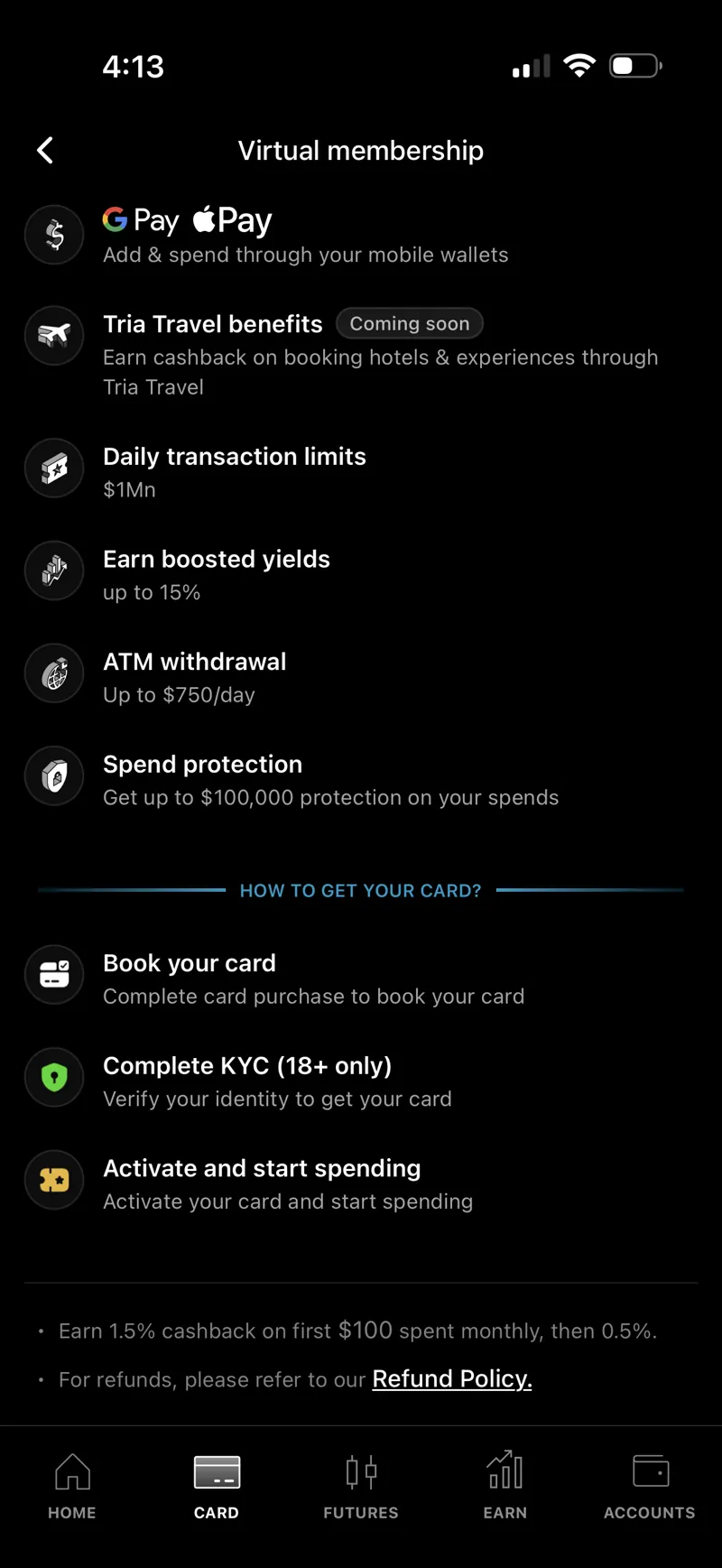
SpendNode app screenshot
Tria Virtual Card - The affordable self-custodial entry point. The in-app membership screen confirms the Season 3 rate: 1.5% cashback on the first $100/month, then 0.5%. It also shows a $1M daily limit and Tria-stated spend protection up to $100,000 (the documented Visa per-claim limits are $10,000 purchase / $2,000 price); the in-app ATM line does not apply since this tier is virtual-only.
$25/yr (free for a limited time) | 1.5% to $100/mo | 1% FX + 0.5%/payment | Virtual only
Physical and Virtual Cards
- Virtual card: Instant issuance
- Physical card: Not available at this tier (virtual only)
- Wallet integration: Apple Pay and Google Pay
Payment Network
- Network: Visa
- Contactless: Yes (NFC via Apple Pay, Google Pay)
- Card type: Debit (self-custodial via account abstraction)
- Custody: Self-custodial (AA smart account on OP, Arbitrum, Solana)
Features
- Cashback: 1.5% on the first $100/month, then 0.5% (net ~1% on the first $100 then ~0% after the 0.5% per-payment fee)
- FX fee: 1% on non-USD spend
- Per-payment fee: 0.5% on every transaction
- Deposit fee: 0% on 1,000+ crypto assets
- APY: Up to 15% on wallet balances
- Price Protection: $2,000
- Purchase Protection: $10,000
- Season 3 points: 1 per $1 spent
- Daily transaction limit: $1,000,000
- Supported chains: Optimism, Arbitrum, Solana
- External wallets: Connect MetaMask, Coinbase Wallet, and others
- Supported assets: 1,000+ (from ETH and USDC to long-tail DeFi tokens)
Fees and Rates
| Fee | Amount |
|---|---|
| Annual fee | |
| FX fee (non-USD) | 1% |
| Per-payment fee | 0.5% |
| Deposit fee | 0% |
| ATM | N/A (virtual only) |
| Cashback | 1.5% to $100/mo, then 0.5% |
| Price Protection | $2,000 |
| Purchase Protection | $10,000 |
| APY on balances | Up to 15% |
Net Returns at Different Spending Levels
| Monthly Spend | Annual cashback (net of 0.5% fee) | Yield on $1K Balance (est. 10%) | Annual Fee | Total Net Return |
|---|---|---|---|---|
| $500 | ~$12 | $100 | -$25 | +$87/yr |
| $1,000 | ~$12 | $100 | -$25 | +$87/yr |
| $2,000 | ~$12 | $100 | -$25 | +$87/yr |
| $5,000 | ~$12 | $100 | -$25 | +$87/yr |
Net of the 0.5% per-payment fee, Virtual's cashback is effectively flat at about $12/year regardless of spend: only the first $100/month earns anything (1% net), and spend above the cap earns 0% net (the 0.5% above-cap rate is cancelled by the fee). The value above the cap is the yield and the protections, not the rate, and non-USD spend carries a further 1% FX. While the fee is waived, add $25 back to each total.
The 1,000+ Asset Advantage
Most free crypto cards restrict you to 1-10 tokens. Tria supports over 1,000 across three chains. This means you can spend directly from your existing portfolio without swapping:
- Hold ETH on Optimism? Spend it directly
- Staked tokens on Arbitrum? Liquidate and spend in one swipe
- Long-tail DeFi positions on Solana? Available for spending
No swap fees, no bridge fees, no intermediate steps. The card handles the conversion at point of sale.
Limits and Restrictions
| Limit | Amount |
|---|---|
| Annual fee | $25 |
| Daily transaction limit | $1,000,000 |
| FX fee (non-USD) | 1% |
| Per-payment fee | 0.5% |
| Deposit fee | 0% |
| Cashback | 1.5% to $100/mo, then 0.5% |
| Price Protection | $2,000 |
| Purchase Protection | $10,000 |
| APY | Up to 15% (variable) |
| Supported assets | 1,000+ |
| Supported chains | Optimism, Arbitrum, Solana |
| Card type | Virtual only |
| Mobile wallets | Apple Pay, Google Pay |
| KYC | Required |
| Regions | EEA, UK, US, Global |
Rewards on This Tier
The Tria Virtual Card earns 1.5% cashback on the first $100 of monthly spend, then 0.5% above that. Net of the new 0.5% per-payment fee that works out to about 1% on the first $100 and roughly 0% above it, so the cashback does not scale with spend. All tiers also earn up to 15% APY on idle wallet balances. $2,000 Price Protection and $10,000 Purchase Protection are included on every tier.
Break-Even Math
Virtual no longer breaks even on cashback alone at $25. Net of the 0.5% per-payment fee, only the first $100/month earns anything (1% net, about $12/year), and spend above the cap earns 0% net - so the cashback cannot cover the $25 fee by itself.
The yield carries it: about $100/year on a $1,000 idle balance clears the fee on its own. While the Virtual fee is waived (free for a limited time), it is worth holding regardless; at full price, treat it as a yield-and-protections card, not a cashback one.
How This Tier Compares
| Feature | Tria Virtual | KAST K Card | MetaMask Virtual | ether.fi Core | Bleap |
|---|---|---|---|---|---|
| Annual fee | $25 | $0 | $0 | $0 | $0 |
| Cashback | 1.5% (to $100/mo) | 1.5% USD ($2K/mo cap) | 1% | 3% | 2% (capped) |
| FX fee | 1% (+0.5%/payment) | 0.5-1.75% | 0% | 1% | 0% |
| Yield | Up to 15% | No | No | ETH staking | 5-11% |
| Custody | Self-Custodial | Custodial | Self-custodial | Self-custodial | Self-Custodial |
| Supported assets | 1,000+ | USDC/USDT | 9 tokens | ETH/USDC | USDC |
| Regions | Global | Global | Supported markets | US/UK/EEA | EEA/CH |
ether.fi Core delivers 3% for free with a well-established platform. If raw cashback percentage is your priority and you hold ETH, ether.fi is hard to beat on pure spending returns.
KAST K Card and the Pengu Card collection pay 1.5% USD cashback on the first $2,000/month. Custodial prepaid model with 0.5-1.75% FX. Rewards land as in-app card credit on a 14-day hold, not cash. If you need self-custody, KAST is not the alternative.
Note the caps differ sharply, though: KAST applies its 1.5% to the first $2,000/month, while Tria Virtual's 1.5% covers only the first $100/month (then 0.5%), so KAST pays more cashback above $100/month - Tria's edge here is self-custody and asset breadth, not the rate or FX (Tria now charges 1% FX plus a 0.5% per-payment fee).
MetaMask Virtual offers proven reliability (4.74 stars, 73K reviews) with 1% cashback and 1% cross-border fee (Metal has 0% FX at $199/year). Slightly lower rate than Tria but on a battle-tested platform with massive user base.
Bleap matches on self-custody via account abstraction and offers 5-11% yield. Limited to EEA/Switzerland and capped 2% cashback ($10/month max). Tria is broader on regions and supported assets; both cap cashback now, with Tria's 1.5% running to the first $100/month (then 0.5%).
Tria Virtual uniquely combines self-custody + 1.5% cashback (on the first $100/month, then 0.5%) + yield + 1,000+ assets + $2,000/$10,000 protections for just $25/year (currently free for a limited time). No other option checks all five boxes.
The Upgrade Path
| Feature | Virtual (you are here) | Signature | Premium |
|---|---|---|---|
| Annual fee | $25 | $109 | $250 |
| Cashback (headline) | 1.5% | 4.5% | 6% |
| Monthly spend at headline rate | $100 | $1,000 | $2,000 |
| Rate above cap | 0.5% | 1% | 1% |
| Card type | Virtual | Metal | Metal |
| ATM | N/A | 2% | 0% ($750/day) |
| Daily transaction limit | $1M | $1M | $1M |
| Visa travel perks | Auto rental CDW, concierge | Full suite (auto rental, baggage, hotel, concierge) | Full suite (identical to Sig) |
| Price protection | $2,000 | $2,000 | $2,000 |
| Purchase protection | $10,000 | $10,000 | $10,000 |
Signature is worth it above about $200/month (its higher rate covers the $84 fee difference). Premium is worth it above about $783/month over Signature (extra 1.5% covers the $141 fee difference). Use Virtual to validate the platform first.
Real User Scenarios
Scenario 1: Kevin (Dublin Junior Developer, EUR 800/month spending)
Setup:
- Tria Virtual Card (EEA, $25/year)
- Uses as secondary alongside MetaMask Virtual
- 100% EUR domestic, Apple Pay for daily purchases
- Holds 12 different tokens across OP and Arbitrum
| Item | Amount |
|---|---|
| Monthly spend | EUR 800 (domestic) |
| Annual cashback (1.5% to EUR 100/mo, 0.5% above) | EUR 60/yr gross |
| Less 0.5% per-payment fee | -EUR 48/yr |
| Annual yield on EUR 500 balance (est. 10%) | EUR 50/yr |
| Annual fee | -EUR 25 |
| Net annual return | +EUR 37 |
His verdict: "The 1,000+ asset support is what makes Tria different. I hold small positions in 12 tokens and can spend any of them without swapping first. MetaMask gives me 1% but only supports 9 tokens. ether.fi gives me 3% but only ETH and USDC.
"The cap plus the new 0.5% fee leave my cashback at about EUR 12/year net on EUR 800/month, since only the first EUR 100/month earns anything after the fee - but as a self-custodial secondary card that spends any of my tokens, plus EUR 50 of yield and $2,000 Price Protection, it still clears its EUR 25 fee on the yield alone. For pure cashback I'd reach for ether.fi's 3%."
Scenario 2: Priya (London Crypto Student, GBP 500/month spending)
Setup:
- Tria Virtual Card (UK, $25/year)
- 80% GBP domestic, 20% international purchases (online)
- Uses Google Pay exclusively
- Keeps GBP 300 idle balance for yield
| Item | Amount |
|---|---|
| Monthly spend | GBP 500 (20% international) |
| Cashback (1.5% to GBP 100/mo, 0.5% above) | GBP 42/yr gross |
| Less 0.5% per-payment fee | -GBP 30/yr |
| Less 1% FX on ~20% international | -GBP 12/yr |
| Yield on GBP 300 balance (est. 10%) | GBP 30/yr |
| Annual fee | -GBP 25 |
| Net annual return | +GBP 5 |
Her verdict: "I compared this to KAST's free Standard tier and the Pengu-branded version. Both headline 1.5%, but KAST applies it to the first $2,000/month while Tria Virtual caps the 1.5% at just GBP 100/month (then 0.5%), so KAST actually pays more cashback - roughly GBP 90/year versus about GBP 0 net here once the new 0.5% fee and 1% FX are counted.
"KAST is custodial and the rewards never leave the app, though. I am really paying GBP 25/year for self-custody and the $2,000/$10,000 protections, with the yield covering the fee - the cashback is no longer the reason. I am testing for 3 months before deciding if Signature ($109, 4.5%) is worth the upgrade."
Scenario 3: Marco (Milan Freelancer, EUR 1,500/month spending)
Setup:
- Tria Virtual Card (EEA, $25/year)
- Freelance income in mixed crypto, spends for daily expenses
- 70% EUR domestic, 30% international client dinners
- Holds USDC, ETH, ARB, and OP in Tria wallet
| Item | Amount |
|---|---|
| Monthly spend | EUR 1,500 (30% international) |
| Cashback (1.5% to EUR 100/mo, 0.5% above) | EUR 102/yr gross |
| Less 0.5% per-payment fee | -EUR 90/yr |
| Less 1% FX on ~30% international | -EUR 54/yr |
| Yield on EUR 2,000 balance (est. 10%) | EUR 200/yr |
| Annual fee | -EUR 25 |
| Net annual return | +EUR 133 |
His verdict: "At EUR 1,500/month the cap and the new fees really bite - net of the 0.5% per-payment fee and the 1% FX my Virtual cashback is actually slightly negative, so the card nets about EUR 133/year on the yield alone.
"Signature earns 4.5% on the first EUR 1,000 then 1%, roughly EUR 600 gross; net of the same fees and its EUR 109 fee, plus the ~EUR 200 yield, it lands near EUR 547 - far more on a like-for-like basis. At my spend the upgrade is a no-brainer; I am moving to Signature for the higher cap, the metal card, and the Visa Signature perks. Tria's FX is now 1%, the same as ether.fi, so FX is no longer a reason either way."
Is the Tria Virtual Card Safe?
Your crypto sits in an account abstraction smart account on Optimism, Arbitrum, or Solana. When you swipe, the exact amount is liquidated at point of sale. No exchange deposits, no custodial intermediary, no counterparty risk.
Your wallet funds: Your smart account persists on-chain. Funds are recoverable through the blockchain. The exact recovery process depends on Tria's AA implementation - verify that you can interact with your smart account independently. This is stronger than custodial cards (where your funds vanish with the exchange) but less independent than hardware wallet self-custody (where you have a seed phrase).
Your card: Deactivated immediately. Virtual-only means no physical backup. Apple Pay and Google Pay stop working.
Your earned cashback: Any pending cashback not yet distributed is at risk. Withdraw cashback promptly when credited.
Your yield deposits: The "up to 15% APY" routes through DeFi protocols. If underlying protocols fail or Tria's yield infrastructure goes offline, deposits could be affected.
Best practice: Keep only what you plan to spend in the next 30 days loaded. Hold long-term savings in a hardware wallet or fully independent self-custodial solution.
Who Should Choose This Tier
Our view: The Tria Virtual Card is the most affordable way to test self-custodial spending with cashback. For just $25/year (currently free for a limited time), you get 1.5% cashback on the first $100/month (then 0.5%), up to 15% yield on idle balances, $2,000 Price Protection, $10,000 Purchase Protection, and support for 1,000+ crypto assets across three chains. The $1,000,000/day limit covers any everyday spending.
No other card at this price point offers the combination of self-custody, cashback, yield, protections, and 1,000+ asset support. ether.fi Core beats on cashback rate (3% vs 1.5%) and costs $0.
KAST's free K Card and Pengu Card collection match Tria Virtual's 1.5% headline and apply it to a far higher $2,000/month (versus Tria's $100/month cap), though KAST is custodial with cashback locked into the app. Neither offers Tria's asset breadth, multi-chain coverage, or buyer protections.
Start here. If the experience meets your expectations, Signature raises the rate to 4.5% (on the first $1,000/month) with Visa Signature travel perks for $109/year, and Premium to 6% (on the first $2,000/month) for $250/year.
Virtual card spend also earns Season 3 points (1 per $1) toward Tria's mystery-box program, but the meaningful boxes require millions of points or large Tria-equity balances, so treat points as a lottery-style extra rather than core value. The Tria vendor page has the full points breakdown.
Sources and Verification
All card specs, fees, and limits verified from:
- Tria Official
- In-app screenshots verified June 2026 (Season 3)
Written by Aleksandar Dukic
FAQ
Does the Tria Virtual Card have a promo code or discount?
The Tria Virtual access code is 2C5YNG8981, applied automatically through SpendNode's Tria link.
It is a referral/access code, not a discount: as of Season 3 the Virtual tier is $25 at standard pricing, though Tria is currently waiving it (free) for a limited time.
This is a debit card. Some merchants with pre-authorization holds (hotels, car rentals) may temporarily hold funds beyond the transaction amount.
You retain custody of your funds until the moment of spending. Your balance is not exposed to provider insolvency risk.
Fees shown above are the card's disclosed fees. Additional costs may apply: Visa/Mastercard network spread (typically 0.5-0.9%), crypto-to-fiat conversion spread at point of sale, and blockchain gas fees for on-chain top-ups.
Found any issues?
User Reviews
Reviews are moderated and may take a moment to appear.
Recent Updates to Tria Virtual Card
- Tria added a 1% FX fee and a 0.5% per-payment fee
- Net of the fee, Virtual now earns about 1% on the first $100/month and little above it, so it's best held for its yield and buyer protections rather than cashback
- Season 3 capped cashback at 1.5% on the first $100/month, then 0.5% above that
- Removed the TRIA staking bonus and set the list price to $25/year (currently free for a limited time)